What does it do?
The amph4pop model simulates the lives of female common toads (Bufo bufo).
It simulates their central-place foraging around their breeding ponds, offspring production and the survival of adults and juveniles.
This enables the model to predict the relative abundance of common toads across a landscape.

CC BY-SA 2.0
Where does it come from?

The amph4pop model was co-created by the UK Centre for Ecology & Hydrology, Amphibian and Reptile Groups of the UK and Froglife.
Amph4pop model development is led by Emma Gardner.
How does it work?
Amph4pop reads in a landcover map plus additional maps giving the locations of fine-scale habitat features (e.g. hedgerows, field margins).
It combines these with expert opinion estimates of the amount of breeding resources and foraging resources each landcover type is expected to offer to common toads. This allows the model to map the aquatic breeding resources and map the terrestrial foraging resources provided by the landscape.
It then places breeding females in the margins of waterbodies and uses information on how far common toads typically travel away from their breeding sites to work out the amount of terrestrial foraging resources the female toads would be able to gather from the surrounding landscape.
It assumes that common toads spend more time foraging in nearby places and places with more foraging resources.
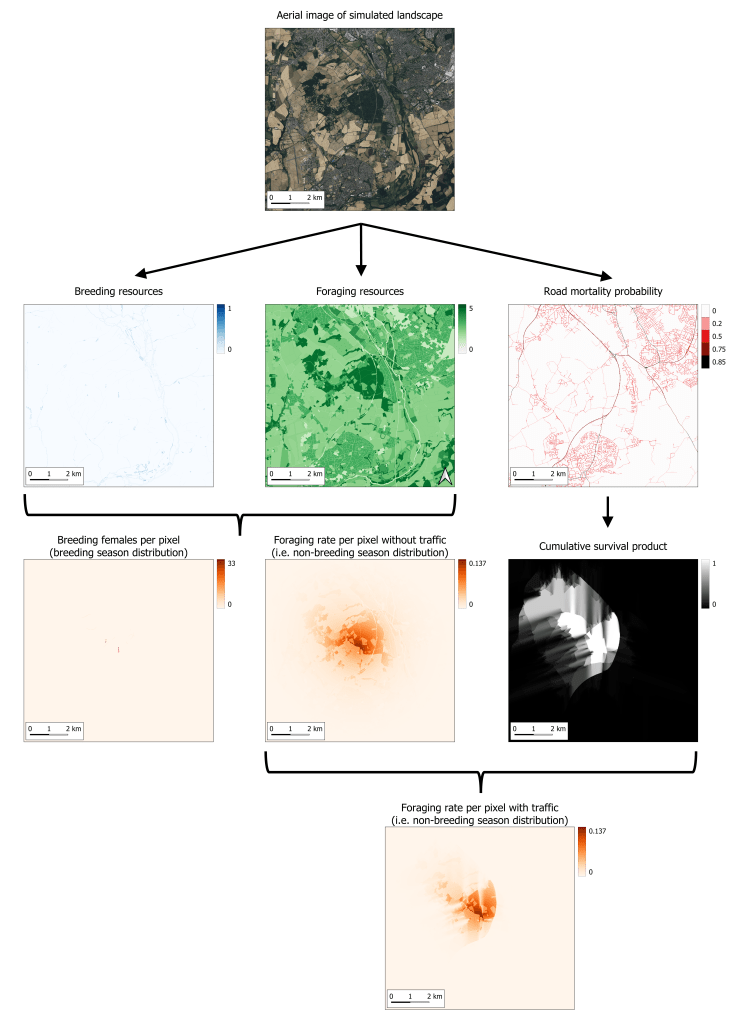
The model assumes that female toads who gather more food lay more eggs.
It then uses the input tadpole survival probability to calculate the number of eggs that survive the aquatic tadpole stage to reach metamorphosis (the process whereby tadpoles turn into tiny toads). It does this ensuring that the number of surviving tadpoles doesn’t exceed the maximum tadpole density the breeding site could sustain.
The input adult survival probability is used to calculate the number of existing adult females that survive to the next breeding season.
We assume half the metamorphs are female and they join this breeding population. The surviving adult females and the recruited juveniles, which were dispersed across the terrestrial foraging resources, are sent back to the breeding waterbodies.
The model loops round and round multiple generations to work out where common toads would be able to survive, given the composition and configuration of habitat resources provided by the input landscape.
Amphibians have a high risk of road mortality so the model offers the option to also account for this. It does this by combining a road map with information on the probability of mortality on different classes of roads, based on their expected traffic levels.
What knowledge does the model use?
The amph4pop model is parameterised for common toad.
It uses:
- expert opinion on common toad habitat preferences from a survey of 10 experts in common toad ecology, including academic researchers, NGO staff, ecological consultants and conservation volunteers
- literature data on tadpole densities, clutch sizes, movement ranges and survival probabilities
How do we know it works correctly?
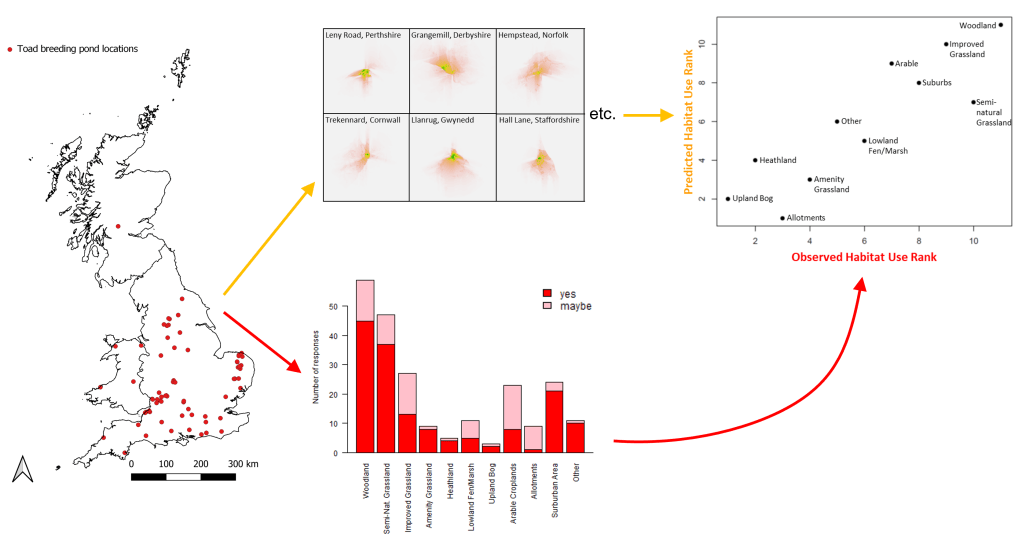
We compared amph4pop model predictions for toad habitat use to observations of migrating common toads made by Toad Patrollers taking part in Froglife’s Toads on Roads project at 70 sites across Great Britain.
How has amph4pop been used?
We have shared amph4pop model predictions with:
- Toad Patrollers who would like to see where their toads are expected to be spending their time when they’re not at the breeding pond.
- Toad Patrollers who would like evidence of how their toad populations might be affected by proposed developments.
- Froglife’s Discovering Dew Ponds project to illustrate how their pond restorations fill an important resource gap in the landscape.
- The Saving Nidderdale’s Priority Ponds project run by Freshwater Habitats Trust and Nidderdale National Landscape, to help with targeting citizen science survey effort.
- Chester Zoo, to help with choosing where to improve habitat provision for toads on their estate.
We’ve also used amph4pop to:
- explore with local communities how past land use changes have affected common toads.
- explore how future land use changes might affect common toads, working with Defra’s national evidence teams.
Visit our pages on supporting decision-making to find out more about this work.
 *4pop models