What does it do?
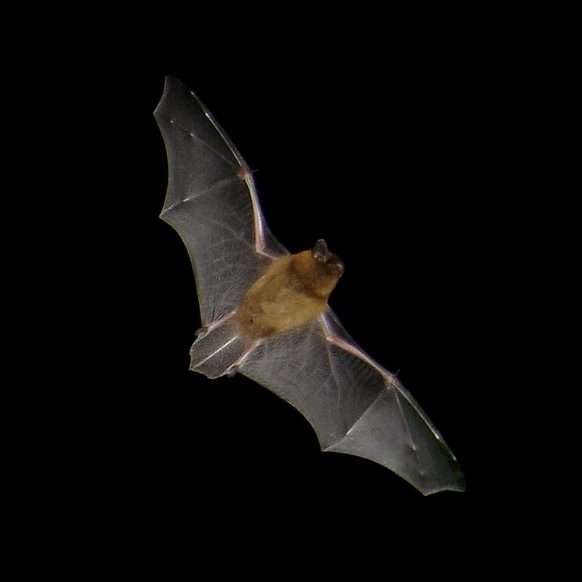
The bat4pop model simulates the lives of female bats.
It simulates their central-place foraging around their maternity roosts during the breeding season, pup production and the survival of adult and juvenile bats.
This enables the model to predict the relative abundance of bats across a landscape.
Where does it come from?
The bat4pop model was co-created by the UK Centre for Ecology & Hydrology and the Bat Conservation Trust.
Bat4pop model development is led by Claudia Acerini.
How does it work?
Bat4pop reads in a landcover map plus additional maps giving the locations of fine-scale habitat features (e.g. hedgerows, field margins).
It combines these with expert opinion estimates of the amount of maternity roost opportunities and breeding season foraging resources each landcover type is expected to offer the bats that are being modelled. This allows the model to map the maternity roosting resources and map the breeding season foraging resources provided by the landscape.
The latest version of the model also reads in a map of light pollution and uses this to modify the habitat resource maps based on the bat’s tolerance to light pollution.
It then places virtual maternity roosts in the landscape, putting more in places where there are more roosting resources, and initially populates these with the maximum allowed number of breeding females per roost.
The model uses information on how far bats typically fly away from their roosts, when foraging during the breeding season, to work out the amount of foraging resources the female bats would be able to gather. It assumes that bats spend more time foraging in nearby places and places with more foraging resources.
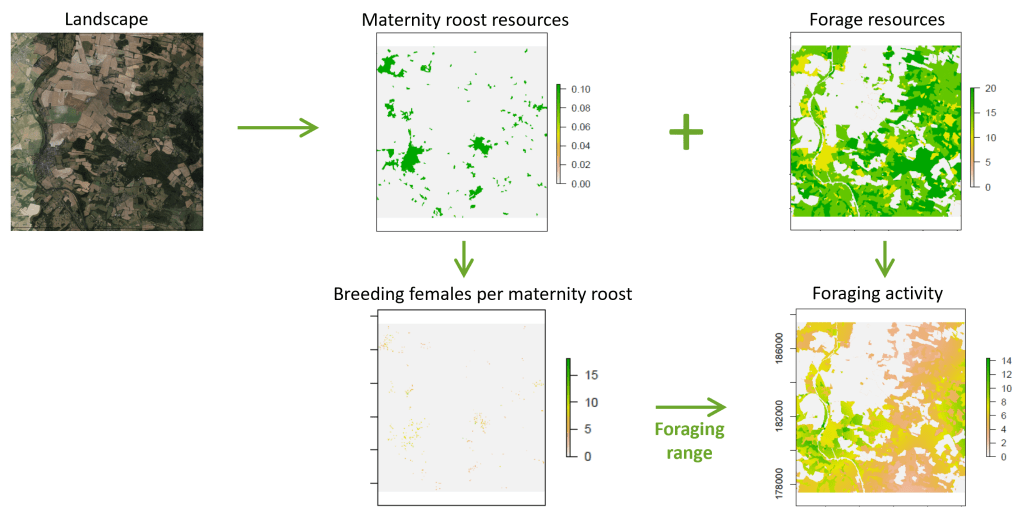
The model assumes that each female bat produces one pup and that the pups of females bats who gather more food are more likely to survive to become independent.
Separate survival probabilities for adults and juveniles are then used to calculate the number of adult and juvenile bats that survive to the next breeding season.
Surviving female juveniles are assumed to stay in their mother’s maternity roost, due to the strong site-faithfulness observed in female bats, and they join the breeding population. The number of breeding females in a maternity roost is capped at the maximum allowed number and any extra bats are lost from the landscape.
The model loops round and round multiple generations to work out where the bats would be able to survive, given the composition and configuration of habitat resources provided by the input landscape.
What knowledge does the model use?
The bat4pop model was originally parameterised for common pipistrelle. Extra parameterisations have now been added for Daubenton’s bats and, serotine and lesser horseshoe bats.
It uses:
- expert opinion on these bats’ habitat preferences from surveys of between 3-10 bat experts (depending on the species), including academic researchers, NGO staff, ecological consultants and conservation volunteers
- literature data on roost densities, roost sizes, movement ranges, survival probabilities and light pollution responses
How do we know it works correctly?
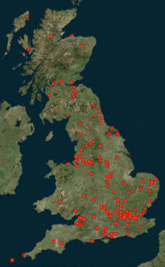
We compared the original bat4pop model’s prediction for common pipistrelle to observed levels of bat activity recorded at 401 sites across Great Britain by volunteer surveys taking part in the National Bat Monitoring Programme’s Field Survey.
We used data from the National Bat Monitoring Programme’s Waterway Survey and Roost Count to test the predictions for Daubenton’s bats and lesser horseshoe bats.
How has bat4pop been used?
We have used bat4pop to explore how much bat distributions in Britain are affected by light pollution.
We’ve also used bat4pop to explore with local communities how past land use changes have affected bats.
Visit our pages on supporting decision-making to find out more about this work.
 *4pop models