What does it do?
The plant4pop model simulates plant competition, survival, seed banks, dispersal and colonisation.
This enables the model to predict the relative abundance of individual herbaceous plant species across a landscape.

CC BY-SA 3.0
Where does it come from?
The plant4pop model was created by researchers working at the UK Centre for Ecology & Hydrology.

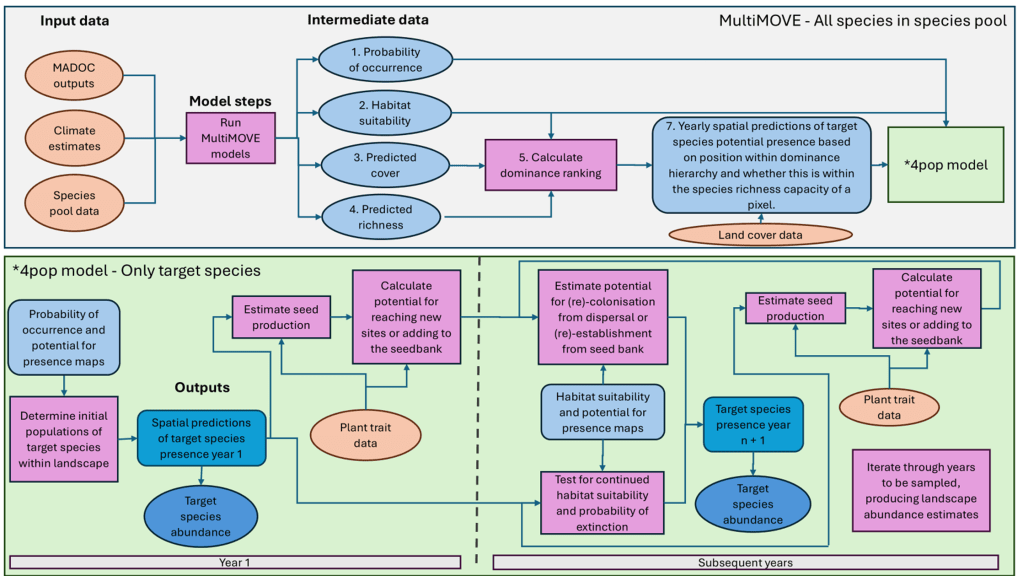
It ‘animates’ the existing MultiMOVE model, which calculates habitat suitability for plants, by combining this with *4pop-derived functions that simulate plant population processes.
Plant4pop model development is led by Adam Kimberley and Simon Smart.
What knowledge does the model use?
The plant4pop model is currently parameterised for ~30 plant species.
It uses:
- estimates of canopy height, soil fertility, pH and wetness for the landcovers present (we often use outputs from the MADOC model)
- climate information for the locations and years being modelled (minimum January temperature, maximum July temperature and total annual precipitation)
- a list of the pool of plant species that can occur in the locality
- literature data on dispersal distances, seed production, seedbank density and seedbank persistence
How does it work?
The diagram below summarises how the combined MultiMOVE-plant4pop model works:
How do we know it works correctly?

We compared plant4pop model predictions to observed plant occurrences recorded across Great Britain during the 2007 and 2024 rounds of the UKCEH Countryside Survey.
How has plant4pop been used?
We have linked plant4pop into a chain of models that enables us to predict:
- how changing levels of air pollution and the nitrogen deposition it causes (as modelled by EMEP4UK) …
- affect soil biogeochemical properties (as modelled by MADOC) …
- which in turn affects habitat suitability for plants (as modelled by MultiMOVE) …
- and their ability to colonise new habitats (as modelled by plant4pop).
We have used this model chain to explore how future air quality and land use changes might affect plants over time, working with Defra’s national evidence teams.
Visit our pages on supporting decision-making to find out more about this work.
 *4pop models