What does it do?
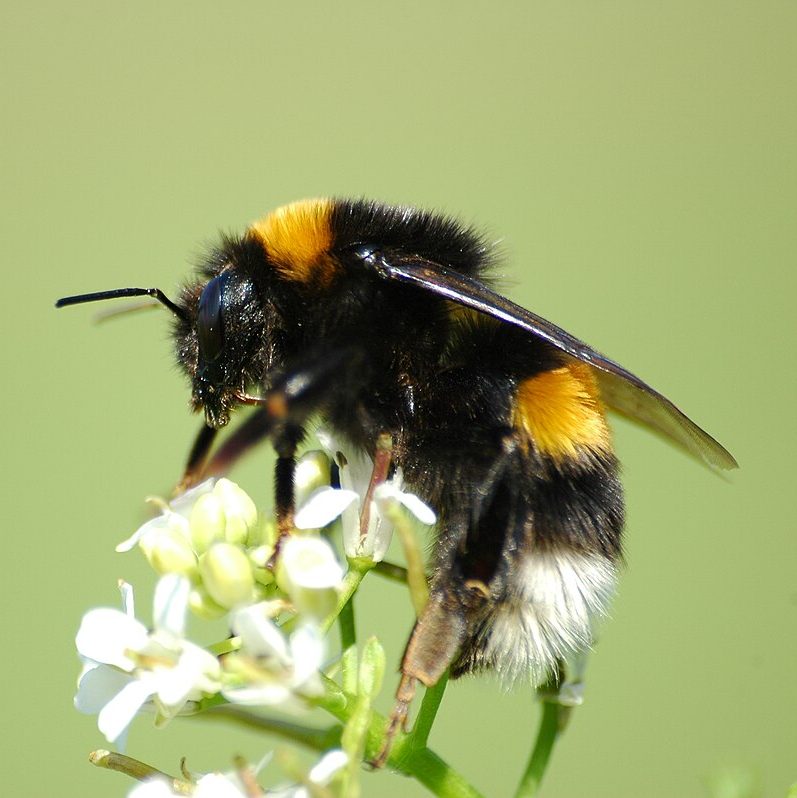
The poll4pop model simulates the lives of bumblebees and solitary bees.
It simulates their central-place foraging around their nests, colony growth and dispersal of new reproductive females. It accounts for seasonality of foraging resources and bee’s preferential use of more rewarding floral resources.
This enables the model to predict the relative abundance of bees across a landscape.
Where does it come from?

Researchers working at Lund University in Sweden took the principles of the Lonsdorf model, which simulates bee foraging, and made it more and more realistic.
The model they eventually created was adapted for use in Great Britain by researchers working at the University of Reading and became the poll4pop model.
How does it work?
Poll4pop reads in a landcover map plus additional maps giving the locations of fine-scale habitat features (e.g. hedgerows, field margins).
It combines these with expert opinion estimates of the amount of nesting and floral resources each landcover type is expected to offer the bees that are being modelled.
It then places virtual bee nests in the landscape, putting more in places where there are more nesting resources.
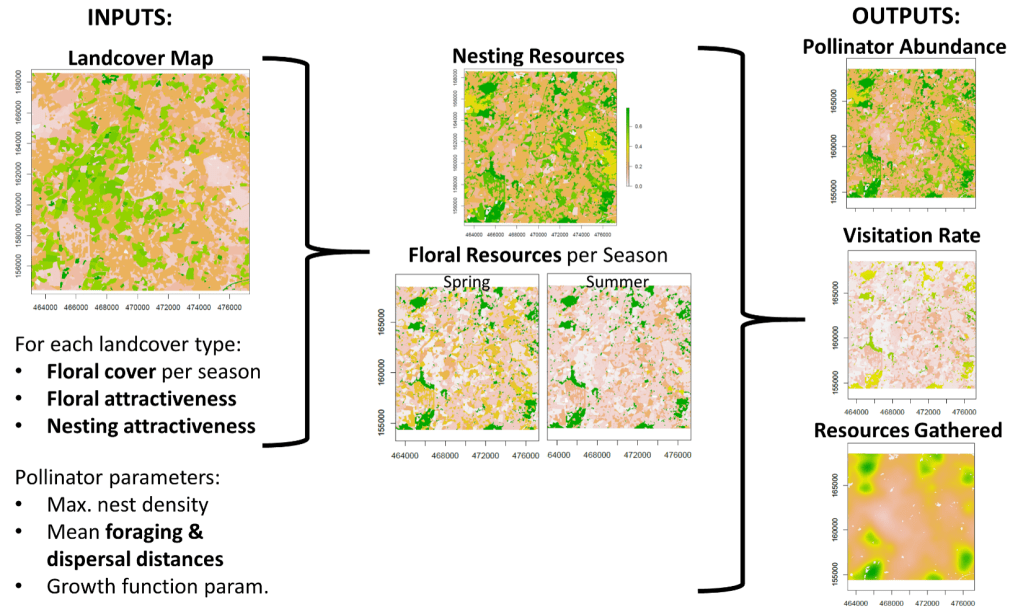
The model uses information on how far foraging bees typically fly to work out the amount of foraging resources the bees from each nest would be able to gather. It assumes that bees spend more time foraging in nearby places and places with more foraging resources.
Nests that gather more food produce more bees and, at the end of the active season, the new reproductive females produced by the nests are dispersed across the landscape to find their own nest sites.
The model assumes that the new females preferentially choose nest sites that are nearby and have more nesting resources. It does not allow the number of nests to exceed the amount of nesting resources available.
The model loops round and round multiple generations to work out where the bees would be able to survive, given the input composition and configuration of the landscape.

What knowledge does the model use?
The poll4pop model is parameterised for ground-nesting bumblebees, tree-nesting bumblebees and ground-nesting solitary bees.
It uses:
- expert opinion on these bees’ habitat preferences from a survey of 10 pollinator experts
- expert opinion on the amount and timing of floral cover offered by different landcover types from a survey of 10 pollinator experts
- literature data on bee nest densities and movement ranges
How do we know it works correctly?

We compared poll4pop model predictions to observed bee abundances recorded at 239 sites across Great Britain.
How has poll4pop been used?
We have used poll4pop to explore:
- the impacts of agri-environment schemes on bees
- how silvoarable agroforestry might support bees
- how solar parks could help support bees
- how we might balance the needs of bees and farmers
- ways to increase and stabilise crop pollination services
- links between bee activity and crop yield
Visit the library to read more about these studies.
 *4pop models