This month’s blog post is written by Hollie Blaydes, a postdoctoral researcher at Lancaster University. She tells us more about her recent paper where she used poll4pop to investigate how solar farms might support bumblebees in the future.
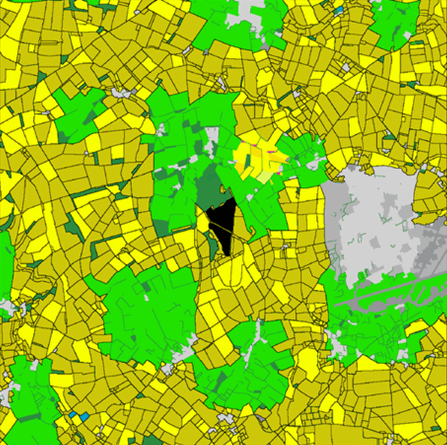
Opening my desktop, I am met with a smattering of shapes strewn across a map of Great Britain, which has been broken up into tiny fragments of different colours.
This scene forms the building blocks of our research: the shapes are solar farms, and the coloured fragments are parcels of land, representing everything from agriculture to woodland to cities and suburbs across the nation.
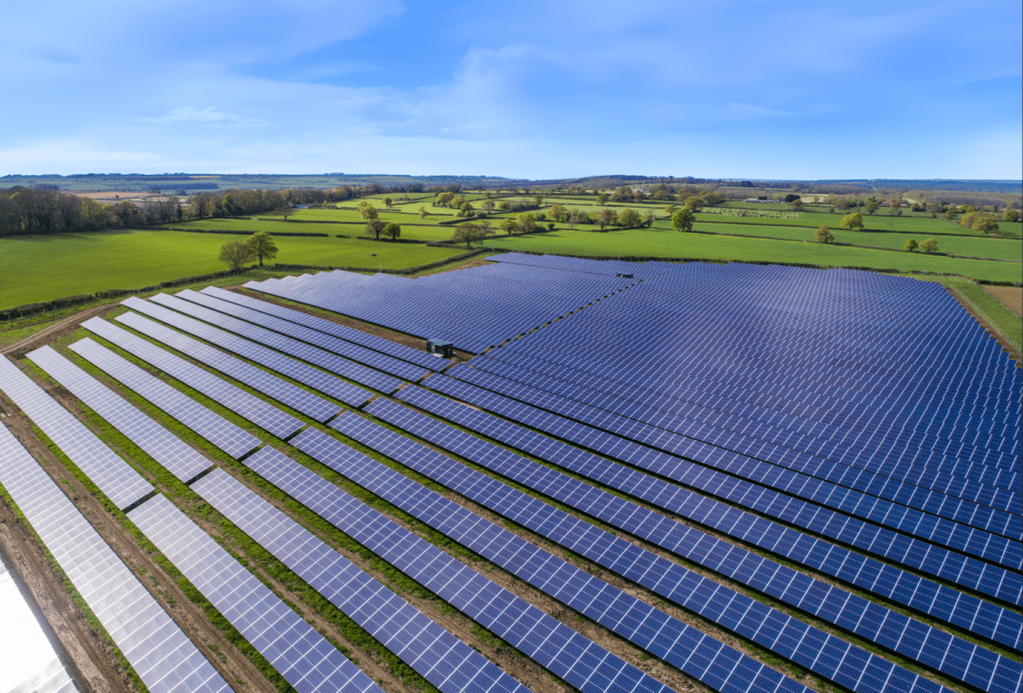
Using this as a starting point, our aim was to work out the impact of solar farms on bumblebees in the present day and in the future.
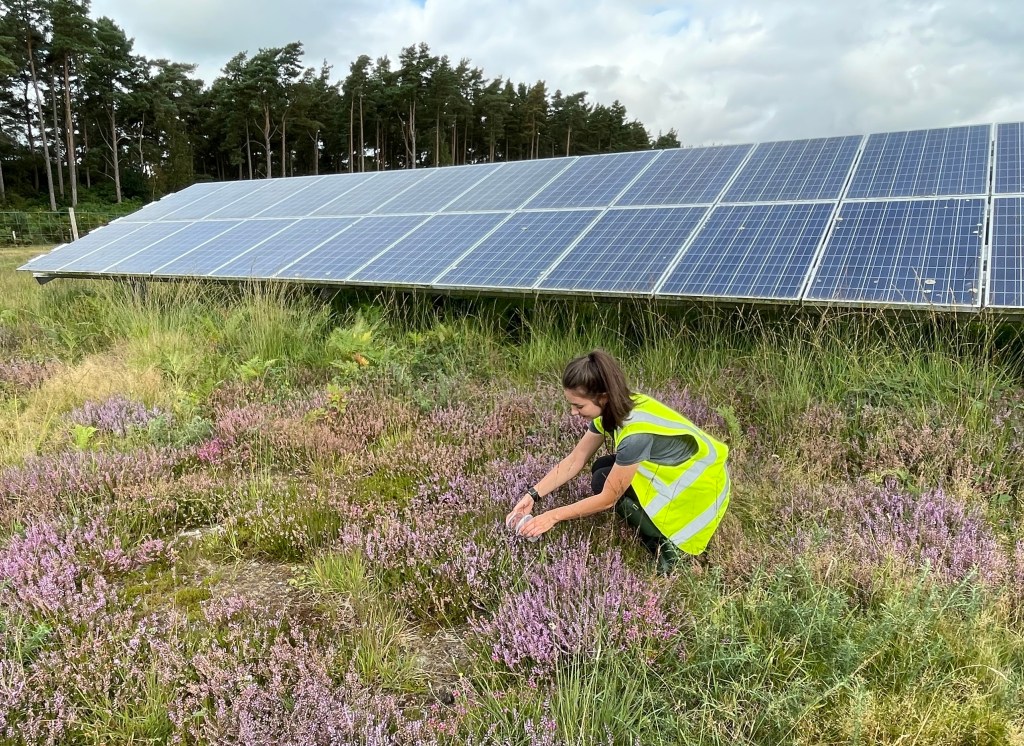
Photograph (c) Hollie Blaydes
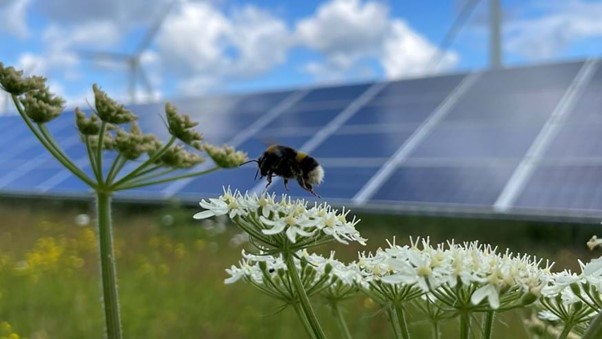
In this study, we were interested to find out how bumblebee numbers might change in response to wildflower meadow creation around the edges of solar farms.
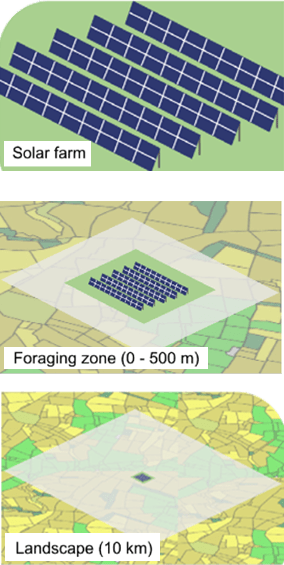
We focused on three spatial scales:
- the solar farm itself
- bumblebee foraging zones surrounding the solar farm
- wider landscapes.
Considering both the inside and outside of the solar farm is important because bumblebees are mobile and how they use habitats depends on what else is nearby.
We wanted to understand more about this in the present day, and also in the year 2050, since solar farms have a lifespan of 25 – 40 years and bumblebee habitats in the surrounding landscape are likely to change in the future.
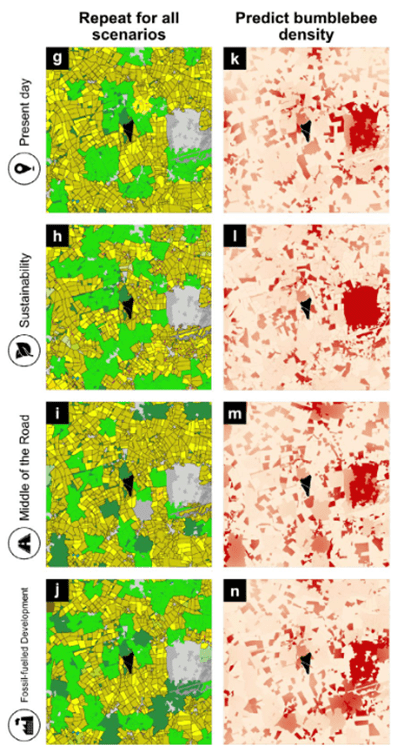
Whilst we don’t know specifically what these wider landscape changes may be, using different future scenarios can give us insights into the range of potential consequences.
We looked at the impact of solar farm management on bumblebees under three future scenarios, which ranged in levels of environmental sustainability.
These future scenarios were mapped by Brown et al. (2022).
We carefully prepared them for input into the poll4pop model, ensuring all habitat features relevant for bees were included.
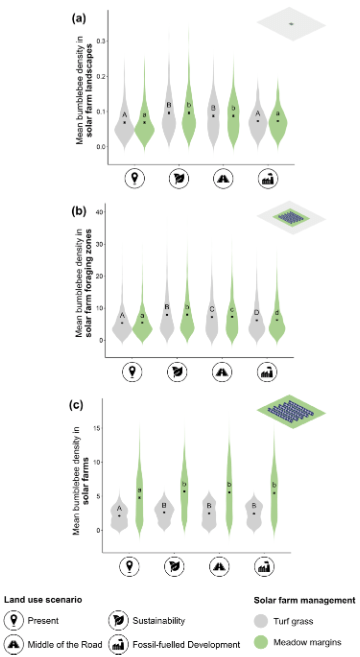
Modelling using poll4pop showed that solar farm management was most important for influencing bumblebee numbers within solar farms, with twice as many bumblebees predicted within those with wildflower meadow margins compared to those without.
Outside the solar farm, the surrounding landscape had a bigger influence with higher bumblebee numbers predicted in the more environmentally sustainable futures.
This suggests that the future benefits of managing solar farms for bumblebees may be limited to the solar farm itself, but even so, these developments could help to protect localised bumblebee populations from wider changes happening outside the solar farms.
Returning to the mosaic of shapes and colours on my computer screen, it is clearer now how each fragment has the potential to affect bumblebees now and into the future.
Through linking solar farm management and wider landscape changes, this study highlighted to us how relatively small interventions can play a role in wildlife conservation in a changing world.
You can read the full study, published in Global Change Biology, here.
 *4pop models